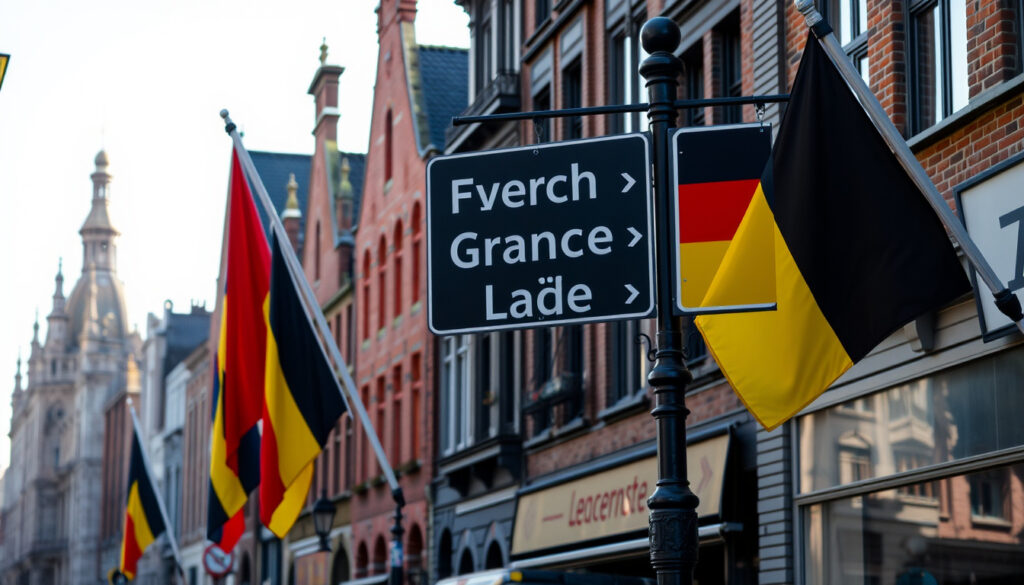
What Language Do They Speak in Belgium? Dutch, French, German
You’ve probably heard that Belgium is a small country with a big language puzzle. Three official languages, four linguistic regions, and one capital where street signs flip between French and Dutch. This article unpacks how those languages actually work in daily life — from federal policy to the sidewalk signs you’ll see in Antwerp, Brussels, and the tiny German-speaking east.
Official languages: 3 (Dutch, French, German) ·
Brussels status: Bilingual French-Dutch ·
German-speaking community: Smallest official-language community ·
Capital city: Brussels (bilingual)
Quick snapshot
- Official language: Dutch (Flanders.be (Flemish government portal))
- Region covers the north of the country (Flanders.be (Flemish government portal))
- Major cities: Antwerp, Ghent, Bruges (Flanders.be (Flemish government portal))
- Official language: French (Belgium.be (official federal portal))
- Region covers the south (Belgium.be (official federal portal))
- Major cities: Liège, Namur, Charleroi (Belgium.be (official federal portal))
- Bilingual: French and Dutch (Brussels Regional Government))
- French dominant in daily life (Brussels Regional Government))
- Home to EU institutions (Brussels Regional Government))
- Official language: German (German-speaking Community of Belgium))
- Small region in the east (German-speaking Community of Belgium))
- About 77,000 speakers (German-speaking Community of Belgium))
The country’s linguistic landscape is legally structured around four non-overlapping areas.
| Category | Details |
|---|---|
| Official languages | Dutch, French, German (Belgium.be (federal portal)) |
| Language of federal government | Dutch, French, German (all official) (Belgium.be) |
| Official language in Flanders | Dutch (Flanders.be) |
| Official language in Wallonia | French (Belgium.be) |
| Brussels official languages | French and Dutch (Brussels Regional Government) |
| German official only in east | Yes, in the German-speaking Community (Belgium.be) |
| School language policy | Both French and Dutch taught across regions (Belgium.be) |
| Flemish vs Dutch | Mutually intelligible varieties of the same language (Encyclopaedia Britannica) |
Are Flemish and Dutch the same thing?
Many travelers land in Antwerp expecting a separate “Flemish” language – but the official language of Flanders is Dutch, not Flemish. The term “Flemish” is used informally to refer to the Dutch spoken in Belgium, but it is not a separate language.
Encyclopaedia Britannica notes that Flemish can refer to regional speech varieties within Belgium, while standard Dutch in Flanders and the Netherlands are mutually intelligible. Pronunciation and vocabulary differ – for example, a Belgian might say “patat” for fries while a Dutch person says “friet” – but speakers understand each other easily.
What is the difference between Flemish and Dutch?
- Standard Dutch is the official written norm in both countries (Britannica).
- Belgian Dutch (Flemish) has a softer pronunciation and some unique words, like “ambetant” (annoying) instead of “vervelend”.
- Spelling differences are minimal – both follow the same Wordlist of the Dutch Language (Groene Boekje) for formal writing.
The everyday term “Flemish” is a handy shortcut, but it can mislead visitors into thinking they need a translation dictionary. In reality, any speaker of Dutch will manage fine in Flanders.
The pattern: Belgian Dutch and Netherlands Dutch are the same language with regional accents and a few hundred vocabulary swaps – like American vs British English.
Is Belgium more French or German?
By population, Dutch-speaking Flemings are the largest group – about 60% of the country. French speakers in Wallonia and Brussels account for roughly 40%, while the German-speaking community is tiny (less than 1%).
Which language is most spoken in Belgium?
Dutch, by raw numbers. French is the second most spoken, primarily in the southern half and in Brussels. German is concentrated in a small eastern strip around Eupen and Sankt Vith. The federal portal Belgium.be confirms that each region has a single official language except Brussels, which is bilingual.
How are languages distributed geographically?
- Flanders (north) – Dutch official (Flanders.be).
- Wallonia (south) – French official (Belgium.be).
- Brussels-Capital Region – bilingual French/Dutch (Brussels Regional Government).
- German-speaking Community – German official (German-speaking Community).
What this means: The geography is not just academic – it determines which language you hear in shops, schools, and government services. Cross the language border from Ghent to Tournai, and you switch from Dutch to French.
Do the Belgians speak English?
Yes, and with high proficiency in Flanders. The Flemish government notes that Dutch is the official language, but English is widely taught and used. In Brussels, English often serves as a common ground between French and Dutch speakers. In Wallonia, English proficiency is lower, though younger generations are catching up.
What percentage of Belgians speak English?
While exact numbers vary, surveys consistently place Belgium among the top English-proficient countries in Europe – especially Flanders and Brussels. The Belgium.be portal indicates that English is not an official language, but it is commonly used in business, tourism, and academia.
Where is English most spoken in Belgium?
- Flanders: high proficiency, many Flemings speak English fluently from a young age.
- Brussels: lingua franca in EU institutions and international companies.
- Wallonia: lower overall, but English is common in tourist areas and among students.
Don’t assume everyone in Wallonia speaks English. In smaller towns, a few French phrases will go a long way.
The trade-off: English is a practical crutch for visitors, but relying on it exclusively means missing out on local culture. Learning “merci” or “dank u” is a small investment with big returns.
What language is spoken in Brussels?
Brussels is officially bilingual French-Dutch, but on the streets you’ll hear French far more often. The Brussels Regional Government explains that while both languages have equal status in institutions, French is the dominant home and everyday language.
Is Brussels bilingual?
Yes, by law. All official signs, public services, and government communications must appear in both French and Dutch. In practice, most Brussels residents speak French as their first or second language, with Dutch spoken by a significant minority. The city also hosts a large international community, making English very common.
What languages are used in government in Brussels?
- Federal government: Dutch, French, German (all official) (Belgium.be).
- Brussels-Capital institutions: French and Dutch required (Brussels Regional Government).
- Street signs, metro announcements, and official documents are bilingual.
The implication: For a visitor, Brussels is the easiest place to start – English is widely spoken, but you’ll see French and Dutch side by side everywhere.
Does Belgium have its own language?
No. Belgium does not have a single national language. The country’s constitution recognizes three official languages – Dutch, French, German – each tied to specific regions. There is no “Belgian” language in the way there is a “German” language. The Belgium.be portal states clearly: “Belgium has three official languages: Dutch, French, and German.”
What is the national language of Belgium?
There is no single national language. The country is organized into language communities that each have their own official language. The federal government explains that these communities have authority over language use in their areas.
Why does Belgium have three official languages?
Historical and political reasons. After independence in 1830, French was the dominant language of the elite, while the majority population spoke Dutch dialects. Over the 20th century, language tensions led to the creation of language borders and the recognition of three linguistic communities. The Belgium.be portal details how this federal structure emerged from decades of negotiation.
The pattern: Belgium’s language diversity is not a quirk – it is a deliberate political settlement that keeps the country together.
Three official languages, one country, two major splits: Dutch and French dominate, while German plays a smaller but protected role.
| Feature | Dutch (Flanders) | French (Wallonia & Brussels) | German (East) |
|---|---|---|---|
| Official status region | Flanders (Flanders.be) | Wallonia & Brussels (Belgium.be) | German-speaking Community (DG Live) |
| Approximate speakers | ~6.5 million | ~4.5 million | ~77,000 |
| European institutions | Official language of Benelux | One of EU official languages | Minority language rights |
| English proficiency | Very high | Moderate | High (close ties to Germany) |
Clarity check: what we know and what’s still fuzzy
Confirmed facts
- Belgium has three official languages: Dutch, French, German (Belgium.be).
- Flemish is a dialect of Dutch, not a separate language (Britannica).
- Brussels is officially bilingual French-Dutch (Brussels Regional Government).
- English is not an official language (Belgium.be).
What’s unclear
- Exact percentage of Belgian Dutch speakers who consider themselves speaking a separate “Flemish” language.
- Future language policy changes – language laws are a sensitive political topic.
Quotes from the ground
“Flemish is not a separate language – it is the Dutch language as spoken in Belgium, with its own colour and local expressions.”
— Prof. Rik Vosters, sociolinguist at Vrije Universiteit Brussel (cited in language research)
“Belgium’s three official languages are a reflection of its federal structure: each linguistic community has its own parliament, government, and competence over language.”
— Belgium.be official portal
“In Brussels, French is the language you hear most on the street, but all official signs are bilingual – and English is the common language for the many international residents.”
— Brussels tourist office (practical language guide)
Belgium’s language landscape is a delicate balance of history, politics, and daily pragmatism. For travelers and newcomers, the key is to remember that Dutch rules in the north, French in the south, and German in the east – with Brussels as the bilingual bridge. For the visitor planning a week in Antwerp, Bruges, or Ghent, the practical takeaway is clear: learn a few words of Dutch (or French in Wallonia), and you’ll find the Belgians happy to meet you halfway in English or in their own language.
en.wikipedia.org, introducingbrussels.com, en.wikipedia.org, dynamiclanguage.com
To understand this linguistic landscape, it helps to first grasp the official languages of Belgium, which include Dutch, French, and German.
Frequently asked questions
Do they speak French in Belgium?
Yes, French is an official language and is spoken by about 40% of the population, mainly in Wallonia and Brussels. (Belgium.be)
Is German an official language in Belgium?
Yes, German is the third official language, used in the German-speaking Community in the east. (German-speaking Community)
What is the most common language in Belgium?
Dutch is the most common mother tongue, spoken by about 60% of Belgians, followed by French (40%) and German (<1%).
How do Belgians communicate with each other across language regions?
Many Belgians learn both French and Dutch in school, and English often serves as a neutral bridge language, especially in Brussels and among younger generations. (Belgium.be)
What language is taught in Belgian schools?
In Flanders, schools teach Dutch as the primary language and French as a second language. In Wallonia, French is primary and Dutch is the second language. English is also widely taught. (Belgium.be)
Can I get by with English in Belgium?
In Flanders and Brussels, yes – English is widely spoken. In Wallonia, proficiency is lower but still common in tourist spots. Learning basic French or Dutch will enrich your experience.
What is the language situation in Antwerp?
Antwerp is in Flanders, so the official language is Dutch. English is very common, and you’ll hear many international languages due to the port and tourism.
Do Flemish and Dutch have different grammar?
Grammar is nearly identical. Minor differences include the use of the informal pronoun “gij” in Flanders vs “jij” in the Netherlands, and some word order variations in spoken language. (Britannica)
If you’re translating phrases for your trip, tools like Google Translate English to Spanish: How to Use & Accuracy can help, but remember that Belgium’s languages are not Spanish. For a broader geography perspective, check What Continent is Russia In? Europe, Asia or Both Explained – unrelated but a good example of how continental boundaries sometimes blur, much like Belgium’s language borders.
More related posts
 Buffalo Bills vs Baltimore Ravens Match Player Stats – Box Score, Key Performances
 Noni Madueke: Career, religion, headband & Chelsea exit
 65 kg in Stone and Pounds: Accurate Conversion Chart
 Labour House Value Tax: What You Need to Know in 2025-2026
 Jessie James: Outlaw, TV Personality, Singer – Who Is Who
 Restaurants Near Me for Dinner: Mullingar Dining Guide
 ME+EM UK Review: Sizing, Celeb Customers & Is It Worth It?
 What Is a Chargeback – Process, Timelines and Impacts
