Exeter City F.C. – History, Stadium and League One Status
Exeter City F.C. stands as one of English football’s most distinctive clubs, a supporter-owned entity with deep roots in Devon. The club, nicknamed the Grecians, currently competes in EFL League One and has built a reputation for resilience through decades of fluctuating fortunes. Founded in 1904, the club has experienced the highs of major promotions and the lows of relegation, yet maintains a passionate supporter base that helped save the club from administration in the early 2000s.
The Grecians have carved out a unique place in English football history, holding the record for most seasons in the third tier without ever reaching the second tier. This distinction reflects both the club’s consistent competitiveness at that level and the challenges of breaking through to higher divisions. St James Park has been home since the club’s formation, serving as the backdrop for memorable cup runs and dramatic promotions.
Understanding Exeter City requires examining both their historic achievements and their community-focused model, which sets them apart from many modern football clubs. The club’s journey from St Sidwell’s United through professional status to becoming a pillar of Devon’s sporting culture reveals much about the evolution of English football outside the Premier League spotlight.
What League is Exeter City F.C. In?
Exeter City currently competes in EFL League One, which represents the third tier of the English football pyramid. The club achieved promotion to this level following their runners-up finish in League Two during the 2021-22 season. This marked their return to League One after a decade in the fourth tier, representing one of the most significant achievements in the club’s recent history.
Founded
Current League
Home Ground
Nickname
The club has experienced significant fluctuation between League One and League Two over the past two decades. Following their dramatic promotion under Paul Tisdale in 2008-09, the Grecians established themselves in League One before suffering relegation in 2012. They subsequently rebuilt and reached the League Two play-off finals three times under manager Matt Taylor, losing each final before finally achieving promotion as runners-up in 2021-22.
Key facts about Exeter City’s competitive position include their status as the only club to have played more seasons in the third tier of English football without ever reaching the second tier. The club has finished as league runners-up on four separate occasions: 1932-33, 1976-77, 2008-09, and 2021-22. Their most recent season in League One saw them continue building toward stability at this level.
Exeter City represents a mid-tier EFL club with strong community roots. The club’s current standing reflects their strategic focus on sustainable growth within League One, balancing competitive ambitions with financial prudence typical of supporter-owned clubs.
| Category | Details |
|---|---|
| Current Division | EFL League One (Third Tier) |
| Recent Promotion | 2021-22 (League Two Runners-up) |
| Previous League | EFL League Two |
| Record Third-Tier Seasons | Most seasons without reaching second tier |
| League Runners-up Finishes | 1932-33, 1976-77, 2008-09, 2021-22 |
Where is Exeter City F.C. Based and What is Their Stadium?
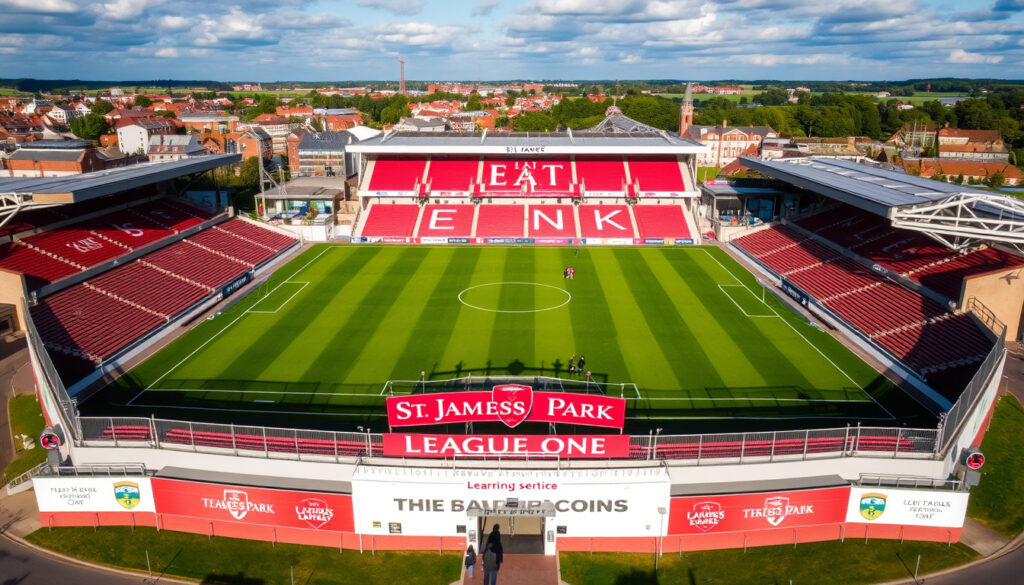
Exeter City F.C. is based in Exeter, the county town of Devon in South West England. The club calls St James Park home, a stadium situated in the St James area of the city. The ground has served as the club’s headquarters since their formation and has undergone numerous renovations over the decades to meet evolving requirements of the Football League.
The stadium’s location in Exeter places the club at the heart of Devon, making them the primary professional football presence in the county. This geographic positioning has contributed to the club’s strong local identity and community connections, with supporters drawn from across the region.
St James Park offers facilities suitable for League One football, providing seating and standing accommodation for home and away supporters. The ground has hosted memorable matches including FA Cup ties against higher-tier opposition and significant league encounters that have shaped the club’s modern history.
Location and Regional Significance
Exeter’s position as the major city in Devon means Exeter City serves as the flagship football institution for a large geographic area. The club’s regional significance extends beyond matchdays, with community programmes and youth development initiatives reaching across the county. This position creates both opportunities and challenges, as the club competes for attention against larger regional clubs from neighbouring counties.
Who Manages and Owns Exeter City F.C.?
Exeter City operates as a supporter-owned football club, with the Exeter City Supporters’ Trust holding the controlling shareholding in the club. This ownership structure represents a significant aspect of the club’s identity, distinguishing them from many modern football clubs controlled by individual owners or investment groups. The supporter ownership model emerged following the club’s escape from administration in the early 2000s, when fans mobilised to secure the club’s future.
The Trust structure means that major decisions affecting the club’s direction require consultation with the supporter membership. This model has enabled Exeter City to maintain financial stability while competing in the EFL, prioritising long-term sustainability over aggressive investment strategies that could jeopardise the club’s future.
Regarding current management, detailed verified information about the present manager would require consultation with up-to-date sources beyond the available research. The club has historically appointed managers with strong connections to the south-west region and has shown loyalty to bosses who demonstrate understanding of the club’s unique circumstances.
The available research does not include verified details regarding the current first-team manager or precise ownership structure specifics. For accurate, current information about Exeter City’s management and ownership, consulting the official club website or EFL documentation would provide the most reliable data.
What is the History of Exeter City F.C.?
Exeter City F.C. traces its origins to St Sidwell’s United, formed in 1901 with players drawn from Exeter Wesleyan United and old boys of St Sidwell’s School. The club evolved into Exeter City A.F.C. in 1908 when it was established as a limited company and gained admission to the Southern League, taking Tottenham Hotspur’s place in the competition. This professionalisation marked the beginning of the club’s journey into organised league football.
The club joined the Football League in 1920 as a founder member of Division Three South, beginning their long association with the third tier of English football. For the first six decades, Exeter remained in lower divisions, experiencing the challenges faced by provincial clubs competing against better-resourced opponents. Their initial promotion came in the 1963-64 season under manager Jack Edwards, when they finished fourth in Division Four, though relegation followed just two seasons later.
The 1970s brought renewed hope when Bobby Saxton guided Exeter to promotion in 1976-77, establishing the club in the Third Division for seven seasons before relegation in 1984. The defining achievement in Exeter’s history came under Terry Cooper, who led the club to the Fourth Division title in 1989-90—their only major league championship. This triumph represented the pinnacle of the club’s competitive achievements and remains a source of great pride for supporters.
Exeter City’s Fourth Division title in 1989-90 under Terry Cooper represents their sole major league championship. The achievement occurred during a period when the club demonstrated exceptional consistency and goalscoring ability across a 42-game season.
The Conference Years and Recovery
The early 2000s brought Exeter’s darkest period when they lost Football League status at the end of the 2002-03 season. The club entered administration and faced an uncertain future. However, the supporters mobilised to form the Exeter City Supporters’ Trust, which eventually secured control of the club and guided it through restructuring. The Grecians spent five seasons in the Conference National between 2003 and 2008.
Manager Paul Tisdale led a remarkable recovery, winning the Conference play-offs in 2008 with a 1-0 victory against Cambridge United at Wembley. The achievement completed a dramatic turnaround, and Tisdale built on this foundation to achieve back-to-back promotions, reaching League One in 2008-09. This period ranks among the most successful in the club’s history, transforming Exeter from a struggling non-league outfit to a established EFL club within two seasons.
Recent History and Play-off Heartbreaks
Following their rise to League One, Exeter established themselves in the third tier before suffering relegation in 2012. Manager Matt Taylor then guided the club through a difficult period, reaching the League Two play-off finals three times—2017, 2018, and 2020—only to lose each encounter. These near-misses tested supporter patience but demonstrated the club’s continued competitiveness at the fourth-tier level.
The breakthrough finally came in 2021-22 when Exeter finished as League Two runners-up, securing automatic promotion and ending their decade-long absence from League One. The achievement fulfilled ambitions that had building through those play-off heartbreaks and positioned the club for a new chapter in their third-tier history.
For those interested in the parallel trajectories of regional clubs, the Bristol City F.C. History page provides context on how other South West clubs have developed over similar periods, including contrasting fortunes at higher levels of the English football system.
Exeter City F.C. Culture and Fans
The nickname Grecians derives from Exeter’s historical connection to ancient Greece, with the city historically maintaining trade and cultural links with Greek civilisation. This distinctive moniker sets Exeter apart from most English football clubs and reflects the civic pride and historical consciousness that characterises the club’s supporter culture.
Exeter City’s fanbase has demonstrated remarkable loyalty, particularly during the club’s darkest periods in the early 2000s. When administration threatened the club’s existence, supporters formed the Trust and raised funds to secure its future. This community mobilisation established a template for supporter ownership that has since been replicated by other clubs facing similar crises.
The matchday atmosphere at St James Park reflects the club’s community roots, with attendances bolstered by supporters with multi-generational connections to the Grecians. Family traditions of supporting Exeter City run deep, with many fans able to trace their allegiance back decades through family stories and shared memories of historic matches.
The Exeter City Supporters’ Trust model has ensured that decisions reflect the community’s interests rather than external investor priorities. This structure has helped maintain stability during difficult periods and created accountability mechanisms that keep the club connected to its supporter base.
Rivalries and Community Ties
Traditional rivalries include encounters with Plymouth Argyle, creating the Devon derby, and fixtures against Torquay United. These local competitions carry particular significance given the geographic concentration of football support in the South West. The rivalry with Plymouth, the larger city across the River Tamar in Cornwall, generates the most passionate atmospheres of the season.
Beyond traditional rivalries, Exeter has developed connections with other clubs facing similar challenges in the lower leagues. The supporter movement has also created bonds with fans of clubs facing comparable circumstances, exemplified by the shared experiences documented in stories like Sheffield Wednesday Fan Misconduct, where supporter campaigns have shaped club futures.
Key Milestones in Exeter City F.C. History
Exeter City’s history spans over a century of football evolution, with key moments shaping the club’s identity and trajectory. The following timeline highlights the most significant events in the Grecians’ development.
- 1901: Club founded as St Sidwell’s United, drawing players from local youth and amateur teams in Exeter.
- 1908: Transformed into Exeter City A.F.C. as a limited company, gaining Southern League membership and replacing Tottenham Hotspur.
- 1920: Joined Football League as founder member of Division Three South.
- 1989-90: Won Fourth Division title under manager Terry Cooper—the club’s only major league championship.
- 2003: Lost Football League status at end of 2002-03 season, entering administration.
- 2008: Won Conference play-offs with 1-0 victory against Cambridge United at Wembley.
- 2008-09: Achieved back-to-back promotion, reaching League One under Paul Tisdale.
- 2012: Relegated from League One back to League Two.
- 2017, 2018, 2020: Reached League Two play-off finals under Matt Taylor, losing all three.
- 2021-22: Finished League Two runners-up, securing promotion back to League One.
What We Know and What Remains Unclear About Exeter City
Understanding Exeter City requires distinguishing between well-documented historical facts and areas where current information remains limited. This clarification helps readers appreciate the boundaries of verified knowledge while identifying gaps that require further research.
Established Information
- Founded in 1904 as St Sidwell’s United, becoming Exeter City A.F.C. in 1908
- Currently competes in EFL League One (2021-22 promotion as runners-up)
- Home ground is St James Park in Exeter, Devon
- Supporter-owned through Exeter City Supporters’ Trust
- Nicknamed the Grecians
- Fourth Division champions in 1989-90 (sole major league title)
- Conference play-off winners in 2008 with subsequent back-to-back promotions
- Hold record for most third-tier seasons without reaching second tier
- Reached League Two play-off finals in 2017, 2018, and 2020
Information Requiring Verification
- Current manager identity and appointment date
- Precise stadium capacity figures
- Current ownership shareholding percentages
- Current league position and form in 2024-25 season
- Recent squad developments and transfer activity
- Specific financial details regarding club operations
- Youth academy output and development achievements
The Grecians in English Football Context
Exeter City occupies a distinctive position within English football, combining the third-tier pedigree of a historically established club with the community ownership model increasingly associated with clubs seeking sustainability over profit. Their continued presence in League One demonstrates competitive viability despite operating with resources considerably smaller than many rivals.
The club’s trajectory illustrates the challenges facing provincial clubs attempting to progress beyond their historical position. While clubs with larger resources or external investment can accelerate through divisions, Exeter has followed a more measured path, building gradually and maintaining stability through difficult periods. This approach has preserved the club’s existence and community connection at the cost of slower advancement.
Devon’s sporting landscape features Exeter City as the primary professional football presence, with the club representing the county in national competition. This position creates responsibility for developing local talent and providing accessible matchday experiences that maintain community engagement with professional football.
Official Sources and Documentation
Several authoritative sources document Exeter City’s history and current activities. The official club website provides current information on fixtures, results, and club announcements. The EFL official site maintains league records and statistics for all member clubs including Exeter.
The club’s survival through administration and emergence as a supporter-owned entity represents one of English football’s most notable community rescue stories, demonstrating what becomes possible when supporters unite to protect their club’s future.
The comprehensive Wikipedia entry provides detailed documentation of league history, honours, and record performances. For honours specifically, the 11v11 honours record lists all major achievements including league championships, cup victories, and promotion confirmations.
Research materials from football history archives supplement official documentation, with sources such as FCHD.info providing detailed league records and foundation information that contextualises the club’s development through the football pyramid.
Summary
Exeter City F.C. represents a unique combination of historical permanence and community ownership that distinguishes the Grecians from most English football clubs. Founded in 1904 and operating from St James Park, the club has navigated over a century of football evolution while maintaining its Devon roots and supporter-controlled structure. Their record as the club having played most third-tier seasons without reaching the second tier reflects both consistency and the challenges facing provincial clubs with limited resources.
The club’s journey from St Sidwell’s United through Southern League membership, Football League integration, and Conference survival to League One stability demonstrates remarkable resilience. The 1989-90 Fourth Division title remains their sole major championship, while recent achievements including the 2021-22 promotion indicate continued competitiveness. As a supporter-owned club managed through the Exeter City Supporters’ Trust, Exeter provides a model for sustainable football operations that prioritise community involvement over external investment returns.
What is Exeter City F.C. stadium?
Exeter City plays home matches at St James Park, located in the St James area of Exeter, Devon. The stadium has served as the club’s home since their formation in 1904.
Exeter City F.C. notable achievements?
Key achievements include Fourth Division championship (1989-90), Conference play-off victory (2008), back-to-back promotions reaching League One (2008-09), and League Two runners-up finish (2021-22) securing promotion.
Current Exeter City squad?
Current squad details would require verification through official sources. The club competes in League One following 2021-22 promotion as runners-up.
Exeter City F.C. fixtures 2024?
For current fixture information and match schedules, the official club website and EFL fixtures database provide up-to-date listings for the 2024-25 season.
Exeter City nicknames and fans?
The club is nicknamed the Grecians, reflecting Exeter’s historical connection to ancient Greece. Fans operate through the supporter-owned Exeter City Supporters’ Trust, which holds controlling shareholding in the club.
More related posts
 Reverend and the Makers – Tour Dates, Members and Songs
 Houses for Sale Barnsley – Prices, Best Areas and Buyer Guide
 Normal Blood Sugar Levels Chart – UK NHS Guidelines by Age
 Snooker Champion of Champions – 2024 Dates Draw and Guide
 Miss You Meaning: Alternatives, Flirty Tone, Song Origin
 Real Betis vs Real Sociedad: Prediction, Stats & Lineups
 65 kg in Stone and Pounds: Accurate Conversion Chart
 UK 2025 Pensioners TV Licence: Free Rules & Discounts
