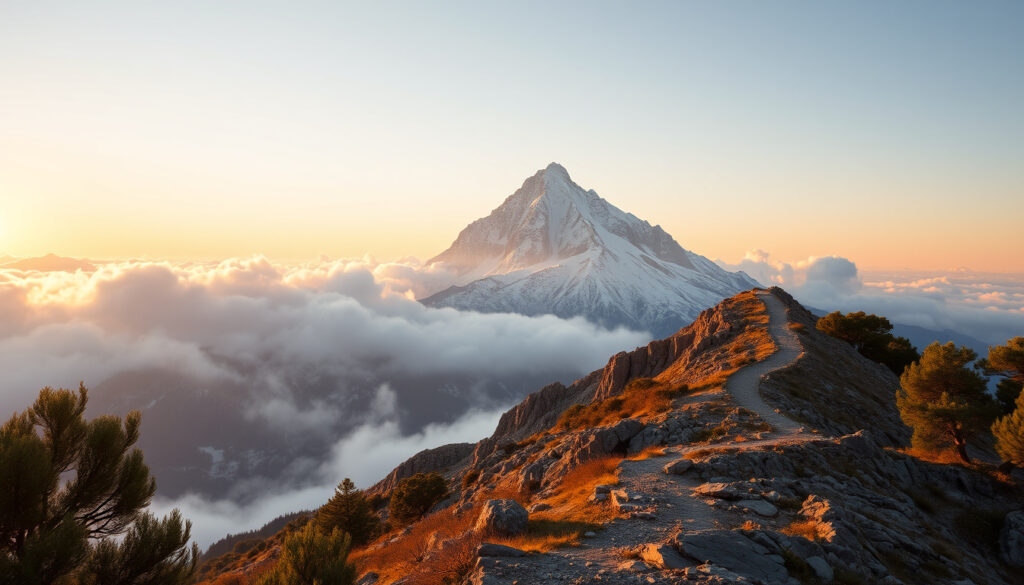
Mount Olympus Guide: Climbing Tips & Mythology
For centuries, the name Mount Olympus has carried a weight that no other mountain quite shares—it’s the legendary home of gods, after all. But beyond the myths, this real-world peak in Greece rises to 2,917 m (9,570 ft) and draws thousands of hikers each year who come for the climb, not just the stories.
Height: 2,917 m ·
First ascent: 1913 ·
Number of peaks: 52 ·
Location: Thessaly, Greece ·
National Park: 1938 ·
Famous for: Home of the Greek gods
Quick snapshot
- Mount Olympus is the highest mountain in Greece at 2,917 m (Explore-Share climbing guide)
- First recorded ascent in 1913 (Much Better Adventures)
- Located in Thessaly, Greece (Much Better Adventures)
- The exact ancient boundaries of the mythological Olympus remain unknown
- Whether Greeks believed gods physically lived there is debated
- 1913: First recorded ascent of Mytikas (Much Better Adventures)
- 1938: Designated as Greece’s first National Park (Much Better Adventures)
- 1981: UNESCO Biosphere Reserve (Much Better Adventures)
- Climbing season June–September (Explore-Share)
- Standard route from Prionia to Mytikas requires 2 days (Much Better Adventures)
Key facts about Mount Olympus at a glance:
| Height | 2,917 m (9,570 ft) |
| First ascent | 1913 by Kakkalos, Boissonnas, Baud-Bovy |
| Number of peaks | 52 |
| National Park year | 1938 |
| UNESCO Biosphere status | 1981 |
| Most climbed route | Prionia–Mytikas |
Where is the actual Mount Olympus?
Mount Olympus is located in the Thessaly region of northern Greece, about 80 km from the city of Thessaloniki. The mountain forms a natural boundary between Thessaly and Macedonia. Its highest peak, Mytikas, reaches 2,917 m (9,570 ft), making it the tallest point in Greece (Explore-Share climbing guide). The mountain is part of the Olympus Range, which includes 52 summits (EverTrek beginner guide).
The area was designated as Greece’s first National Park in 1938 and later became a UNESCO Biosphere Reserve in 1981 (Much Better Adventures climbing guide). The town of Litochoro, at the foot of the mountain, is the primary starting point for climbers.
While the mythological home of the gods was always somewhere in the sky, the physical mountain has been a protected natural site for over 80 years—drawing nature lovers as much as mythology fans.
The implication: Mount Olympus is both a tangible geographic feature and a cultural symbol, making its location significant for reasons that go beyond coordinates.
For more European travel inspiration, check out our Things to Do in Rome: 3-Day Itinerary & Local Tips.
Can beginners climb Mount Olympus?
Do you need ropes to climb Mount Olympus?
- The standard route from Prionia to Mytikas is non-technical and does not require ropes for experienced hikers (Explore-Share climbing guide).
- Ropes may be needed for alternative routes or in bad weather conditions (Much Better Adventures).
- The final scramble to Mytikas involves exposed sections rated Grade III (Explore-Share climbing guide).
How many hours does it take to climb Mount Olympus?
- The typical climb takes two days, with an overnight stay at a refuge (Much Better Adventures).
- Day one: hike from Prionia (1,100 m) to Spilios Agapitos Refuge (2,060 m) via the E4 path, taking 4–6 hours (Much Better Adventures).
- Day two: summit Mytikas and descend, taking 6–8 hours (EverTrek beginner guide).
- Beginners should have fitness for 6–8 hours of mountain trekking with a daypack (EverTrek beginner guide).
The trade-off: the two-day itinerary makes Olympus accessible to fit beginners, but the Grade III scramble means it’s not a casual walk. Preparation matters.
If you’re curious about elite climbing, read about Alex Honnold’s health and wealth.
Which is bigger, Mount Olympus or Mount Everest?
Five key attributes show just how different these iconic mountains are.
| Attribute | Mount Olympus | Mount Everest |
|---|---|---|
| Height | 2,917 m (9,570 ft) | 8,848 m (29,029 ft) |
| Location | Thessaly, Greece | Himalayas, Nepal/Tibet |
| Climbing difficulty | Trekking with scrambling (Grade III) | Expedition with multiple camps |
| Technical requirements | No ropes on standard route | Ropes, crampons, oxygen |
| First recorded ascent | 1913 | 1953 |
Sources: Explore-Share climbing guide, EverTrek beginner guide, Much Better Adventures.
What this means: Everest is more than three times higher and requires a true expedition, while Olympus is a manageable trek for those with moderate fitness. The comparison underlines how different “mountain climbing” can be.
Did Zeus live in Mount Olympus?
Which 12 gods lived on Mount Olympus?
- The Twelve Olympians: Zeus, Hera, Poseidon, Demeter, Athena, Apollo, Artemis, Ares, Aphrodite, Hephaestus, Hermes, and either Hestia or Dionysus (Wikipedia encyclopedia).
- Zeus was the king of the gods, presiding from Mount Olympus.
Who was pregnant with Athena?
- Athena was born from Zeus’s head fully grown and armored (Wikipedia encyclopedia).
- Her mother was Metis, the goddess of wisdom, whom Zeus swallowed to prevent a prophecy.
The paradox: the gods who lived there were immortal, yet the mountain itself remains fixed in the real world of Greece.
Why is Mount Olympus so famous?
Mount Olympus owes its fame to a unique combination of mythology and geography. In ancient Greek religion, it was the dwelling place of the Twelve Olympians, led by Zeus (Wikipedia encyclopedia). This mythology has permeated Western culture for millennia.
Beyond myth, it is the highest mountain in Greece at 2,917 m, offering challenging climbs and rare biodiversity. The area was designated a UNESCO Biosphere Reserve in 1981, recognizing its ecological significance (Much Better Adventures climbing guide).
For many visitors, the chance to stand where gods allegedly stood is the ultimate reason to climb. The mountain delivers both a physical challenge and a cultural connection.
The result: Olympus is one of the few mountains on Earth that is equally famous for a story as for its summit.
Has anyone climbed Mount Olympus?
Yes—the first recorded ascent of Mytikas took place on August 2, 1913, by Swiss photographer Frederic Boissonnas, Swiss author Daniel Baud-Bovy, and Greek hunter Christos Kakkalos (Much Better Adventures historical account). Since then, the mountain has been climbed by tens of thousands of people.
Today, the standard Prionia–Mytikas route is the most popular, especially during the June to September season. The nearby peak Skolio (2,911 m) is often recommended for those who find Mytikas too demanding (EverTrek beginner guide).
Many underestimate the physical demands of the final scramble to Mytikas. A guide is strongly recommended for first-timers, especially if weather turns.
The takeaway: climbing Olympus is a realistic goal for many, but it’s not just a walk in the park—respect the mountain’s mixed reputation.
Timeline of Mount Olympus’s significance
- Antiquity: Revered as home of the Greek gods (Wikipedia encyclopedia)
- 1913: First recorded ascent of Mytikas (Much Better Adventures)
- 1938: Designated as Greece’s first National Park (Much Better Adventures)
- 1981: Declared a UNESCO Biosphere Reserve (Much Better Adventures)
Confirmed facts vs. what’s unclear
Confirmed facts
- Mount Olympus is the highest mountain in Greece at 2,917 m (Explore-Share climbing guide)
- First ascent in 1913 (Much Better Adventures)
- Located in Thessaly, Greece (Much Better Adventures)
What’s unclear
- The exact ancient boundaries of the mythological Olympus are unknown
- Whether ancient Greeks believed the gods physically lived there is debated
“Mount Olympus is the home of the Greek gods and a mountain of exceptional biodiversity.”
“Olympus, Greece’s highest mountain, is the main attraction in a national park rich in history, culture, and ecological diversity.”
— National Geographic (travel and geography authority)
For beginner climbers eyeing their first major peak, Mount Olympus offers a rare blend of accessible challenge and mythological allure. The decision is clear: prepare properly, respect the mountain’s Grade III scramble, and you can stand where the gods once stood—or risk underestimating a climb that demands more than just inspiration.
Frequently asked questions
What is the best time of year to climb Mount Olympus?
The best season is June–September, with stable weather and clear trails. Winter conditions can persist from October to June.
How fit do you need to be to climb Mount Olympus?
You should be comfortable with 6–8 hours of mountain trekking while carrying a daypack. Prior hiking experience is recommended.
Is Mount Olympus a volcano?
No, it is a non-volcanic mountain formed by tectonic uplift.
Who was the king of the gods on Mount Olympus?
Zeus, the god of the sky and thunder, ruled the Olympians from Mount Olympus.
How long is the standard hike to the summit?
The standard two-day route covers about 20 km round trip from Prionia.
Can you drive to the top of Mount Olympus?
No, the summit is only accessible on foot or by climbing. The nearest road access is Prionia at 1,100 m.
Are there guided tours available for climbing Mount Olympus?
Yes, several local operators offer guided climbs, especially from Litochoro.
What is the official name of the highest peak?
The highest peak is Mytikas (also spelled Mytikas), standing at 2,917 m.
More related posts
 Caffeine and Machine The Hill – Inclusive Car Meet Guide
 Premier League Fixtures Today – Full Schedule and TV Guide
 Where to Watch Champions League: Broadcasters & Free Streaming
 Leigh-Anne Pinnock: Twins, Husband, Ethnicity & Net Worth
 Cast of The Waterfront: Full List, Cancellation Reason & FAQ
 Jamie Dornan: Career, Personal Life, and Key Facts (2025)
 Cherry Eye in Dogs: Causes, Treatment & Surgery Cost Guide
 Stranger Thing Sea on 5 Volume 2 Relea e Date
