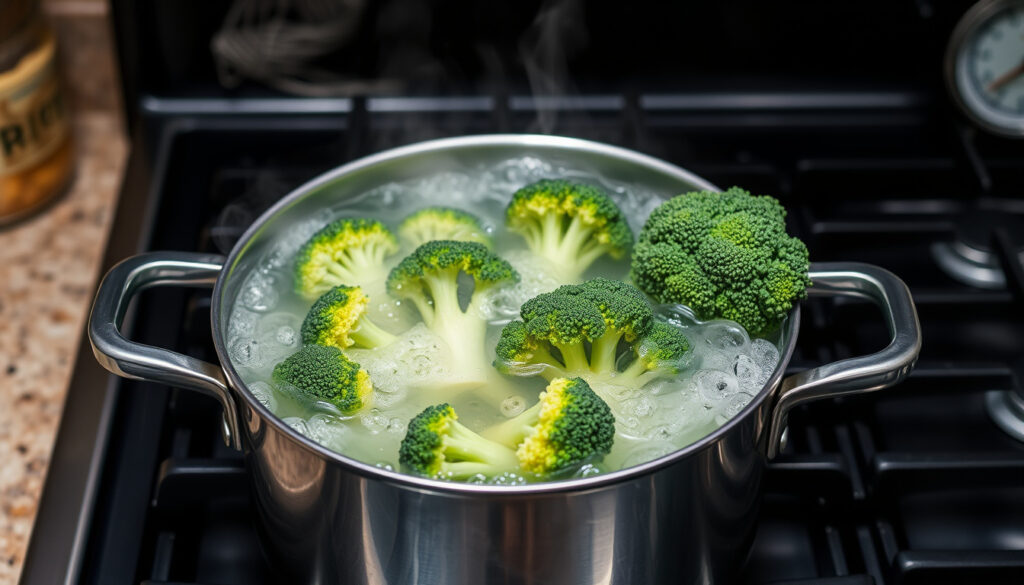
How Long Does Broccoli Take to Boil: Times by Size & Method
Few vegetables divide kitchens quite like broccoli when it hits the boiling pot. Some swear by a quick 2-minute dip for that satisfying crunch, while others leave it in until it’s practically dissolving. The difference between vibrant green florets and sad, mushy stuff comes down to seconds — not minutes. Here’s everything you need to nail the timing every single time.
Florets boiling time: 2-4 minutes · Maximum before mushiness: 3 minutes · Crisp-tender test: Knife pokes easily
Quick snapshot
- Florets need 2-3 minutes for crisp-tender bite (Food Doodles)
- Drain immediately to prevent sogginess (It’s a Veg World After All)
- Cut florets to 1-2 inches for even cooking (A Spicy Perspective)
- Exact nutrient retention percentages vary by study
- Limited data on altitude effects on boiling time
- 1 min: slightly tender, still crunchy (Kitchen Skip)
- 2 min: crisp-tender, fork pierces with resistance (Kitchen Skip)
- 3 min: easily pierced, not mushy (Kitchen Skip)
- Master the 2-3 minute window for best texture
- Use knife test to check doneness
- Drain and serve immediately
How long does broccoli take to boil on stove?
The answer depends almost entirely on how big you cut your florets. Most recipe sources converge on a 2-3 minute window for standard bite-sized pieces, with smaller cuts on the lower end and larger pieces pushing toward 5-6 minutes.
Small florets (2-4 minutes)
Florets cut to about 1 inch need just 2-3 minutes in boiling salted water. According to A Couple Cooks, this is when the florets come out perfectly bright green and crisp-tender. For a crunchier result, pull them at exactly 2 minutes — you’ll notice some resistance when you pierce them with a fork.
Medium florets (4-5 minutes)
Cut florets to 1-2 inches and you’re looking at 3-5 minutes depending on density. The Takeout recommends taking off 1-2 minutes from the standard 5 for smaller cuts, while Savoring the Good settles on 2 minutes for florets alone or 3 minutes if cooking florets with stems together.
Large florets (6-8 minutes)
Leave florets large (2+ inches) and you may need up to 6-8 minutes for the center to fully tenderize. The Takeout suggests adding a minute to the standard time for larger pieces. The trade-off is that bigger cuts tend to lose more vibrant color compared to smaller, faster-cooked pieces.
These size-based ranges give you a practical framework for dialing in timing based on how you’ve prepped your broccoli. The pattern holds across most sources: cut smaller, cook faster; cut larger, add time incrementally.
The single biggest variable is floret size. Cut everything to 1-2 inches and you get consistent 3-minute results every time. Leave them big and you’re gambling with texture.
How to boil broccoli?
Boiling broccoli is straightforward, but the details matter. Here’s the step-by-step approach that works across all floret sizes.
Prep steps first
Start by washing your broccoli under cold water, then cut it into uniform pieces — roughly 1-2 inches across. A Spicy Perspective emphasizes uniform sizing because it ensures everything cooks at the same rate. If you’re using the stems, cut them into similar-sized pieces or cook them separately for 2 minutes before adding the florets, per Food Doodles.
Boiling method
Bring a pot of generously salted water to a rolling boil — you want it to taste like the sea. Add your broccoli all at once. Start your timer the moment the water returns to a boil, not when you first add the vegetables. A Couple Cooks specifies 2½ to 3 minutes from that point for standard florets.
Drain and test doneness
Broccoli is done when a sharp knife slides in easily — it should slide off cleanly when you pull the knife out, according to Savoring the Good. Drain immediately into a colander and do not leave it sitting in the pot — residual heat will continue cooking it. It’s a Veg World After All notes that immediate draining is essential to prevent mushiness.
Broccoli sits in hot water even 60 seconds past its ideal time, and it turns yellowish and soggy, warns Food Doodles. That bright green color is your visual cue — when the florets hit that stunning shade, they’re ready.
What happens if broccoli is cooked longer than 20 minutes?
Nobody cooks broccoli for 20 minutes on purpose, but accidents happen. The result is unmistakable: florets turn olive-brown, collapse into a mushy mass, and lose virtually all structural integrity. Food Doodles notes that even 4-5 minutes produces “very soft” broccoli with no firmness remaining, while 5 minutes leaves florets falling apart when pierced with a fork. At 20 minutes, you’re left with something closer to broccoli soup than a vegetable side.
Overcooking effects
Beyond texture, extended boiling leaches nutrients into the water and destroys the compounds that give broccoli its characteristic flavor. The sulfur compounds that can produce unpleasant odors intensify with overcooking, making 20-minute broccoli both texturally ruined and organoleptically unappealing.
Ideal vs over time
The ideal window is 2-5 minutes depending on size. Within that range, you progress from slightly tender and crunchy (1 minute) to perfectly crisp-tender (2-3 minutes) to soft but still intact (4-5 minutes). Anything beyond that serves no culinary purpose.
Frozen broccoli requires 1-2 extra minutes compared to fresh, which means overcooking is even easier to accidentally achieve with frozen florets. Watch the color closely — frozen broccoli can go from perfect to mushy in under 60 seconds once it hits that 6-7 minute mark.
Is boiled broccoli still healthy?
Boiling broccoli does affect its nutritional profile, but the vegetable remains a nutritional powerhouse even after cooking. The degree of nutrient retention depends primarily on cooking time and whether you consume the cooking water.
Nutrient retention
Broccoli cooked for short periods (2-4 minutes) retains most of its heat-sensitive nutrients, including vitamin C and certain B vitamins. Longer cooking times (8+ minutes) cause greater vitamin loss, particularly of vitamin C, which is water-soluble and leaches into the cooking water. Minerals like potassium and iron remain largely intact regardless of cooking method.
Vs other methods
Compared to steaming, boiling tends to result in slightly greater nutrient loss to the water. However, blanching (30-60 seconds) followed by an ice bath preserves more nutrients than longer boiling and is ideal if you’re not serving immediately. For maximum nutrient retention, Kitchen Skip notes that blanched broccoli should remain tender-crisp, not overly tender — the texture itself signals appropriate cooking time.
What this means: a quick 2-3 minute boil delivers nearly all the nutritional benefits while making broccoli easier to digest than raw florets. The trade-off of a small vitamin C loss is worth it for most diners.
Short boiling (2-3 minutes) gives you nearly all the nutrients with better digestibility than raw broccoli. You’re trading a small amount of vitamin C for improved bioavailability of other compounds like lycopene. For most people, a quick boil is the sweet spot between nutrition and palatability.
What is the first thing you should always do before cooking broccoli?
The universal first step across every credible cooking source: wash the broccoli thoroughly. This isn’t just about removing visible dirt — broccoli has a surprisingly porous surface that can harbor residual pesticides, bacteria, or small insects. Before you even think about cooking, ensure your water is pure by considering a reverse osmosis water filter UK. reverse osmosis water filter UK
Prep hacks
After washing, the next critical step is cutting. A Spicy Perspective and Food Doodles both emphasize cutting florets to a uniform 1-2 inch size for even cooking. Some cooks prefer to soak broccoli in salted water for 5-10 minutes before cooking to draw out any hidden critters, though this is optional.
Timing cuts
If you’re doing prep ahead, you can cut broccoli 24-48 hours in advance and store it in an airtight container in the refrigerator. However, cutting too far in advance (40+ minutes before cooking as one popular Instagram hack suggests) allows oxidation and can slightly affect color, though it won’t ruin the vegetable. For the freshest results and brightest green color, cut just before cooking.
The implication: washing is non-negotiable, but cutting timing is flexible depending on your schedule. Meal preppers can cut ahead safely; same-day cooks should slice just before the pot boils.
Upsides
- 2-3 minutes produces crisp-tender texture
- Bright green color indicates perfect timing
- Simple method requiring minimal equipment
- Nutrients largely preserved at short cook times
- Works for fresh and frozen broccoli
Downsides
- Overcooking happens in under 60 seconds
- Nutrients leach into cooking water
- Less flavorful than roasted or grilled
- Frozen broccoli needs extra time
- Must drain immediately to prevent mush
Getting perfectly crisp and vibrant broccoli florets couldn’t be easier and shouldn’t be boiled longer than a few minutes.
— Food Doodles (recipe publication)
At the 2-minute mark during boiling, broccoli should be tender but still have a slight crunch.
— A Couple Cooks (cooking instruction publication)
Broccoli is done when it easily slides off a sharp knife when poked.
— Savoring the Good (home cooking guide)
These three benchmarks — a few minutes max, tender but with crunch at the 2-minute mark, and a knife sliding through cleanly — give you everything you need to nail broccoli every time.
Related reading: How Long Do Rabbits Live
Home cooks aiming for crisp-tender florets will find these timings align closely with the perfect broccoli boiling timing guide from fellow recipe experts.
Frequently asked questions
How long does broccoli take to boil in microwave?
Microwave boiling typically takes 3-4 minutes on high power with a splash of water and cover. The texture tends toward softer than stovetop boiling, and times vary significantly by microwave wattage. Start checking at 2 minutes and continue in 30-second intervals.
How long does broccoli take to boil from cold water?
Starting from cold water, broccoli takes 8-12 minutes total to reach boiling and cook through. This method is not recommended for optimal texture — always start with boiling water for better control over the final result.
How long to boil broccoli until soft?
If you want soft broccoli (not crisp-tender), cook for 5-7 minutes depending on floret size. At 5 minutes, florets fall apart when pierced with a fork. At 7 minutes, they approach mushy territory.
How long does broccoli take to boil for baby?
For baby food, boil broccoli florets for 6-8 minutes until very soft and easily mashable. Always test the softest floret with your fingers before serving to ensure no firm pieces remain that could pose a choking hazard.
How long does broccoli take to steam?
Steaming takes 5-7 minutes for medium florets — about 2-3 minutes longer than boiling for equivalent texture. The longer time is because steaming uses gentler, more indirect heat compared to direct boiling.
Why cut broccoli 40 minutes before cooking?
Some sources suggest cutting broccoli 40 minutes before cooking to allow cut surfaces to heal and develop protective compounds. However, this practice has minimal culinary benefit and the broccoli may oxidize slightly, affecting appearance. Cut just before cooking for best color.
Is steamed broccoli good for diabetics?
Steamed or briefly boiled broccoli is an excellent choice for diabetics — it’s low in carbohydrates, high in fiber, and contains compounds that may actually help regulate blood sugar. Both cooking methods preserve these benefits when kept under 5 minutes of cooking time.
More related posts
 How Old Is Donald Trump? Age, Birthday, and Family
 Snooker Champion of Champions – 2024 Dates Draw and Guide
 Wallace and Gromit: Vengeance Most Fowl – Stream, Cast & More
 Brown Discharge Before Period: Causes, Tests & When to Worry
 The Life of Chuck: Plot, Cast, and Reverse Narrative
 Does Tea Have Caffeine? Caffeine in Tea vs Coffee Explained
 Vera Farmiga Movies and TV Shows: Complete Career Guide
 Barcelona vs Atlético Madrid – Preview, Lineups, Predictions
