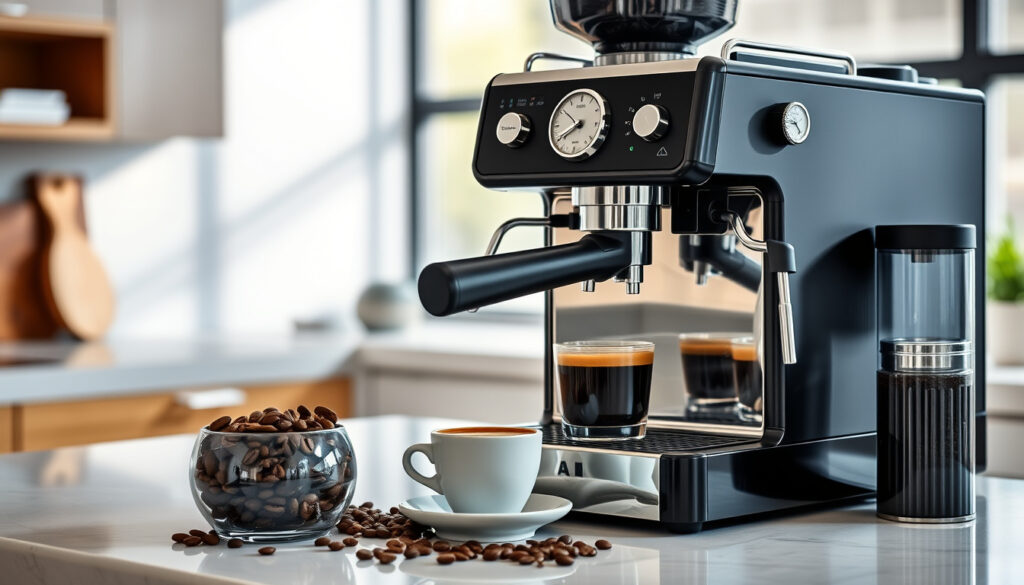
Best Coffee Machine with Grinder 2026: Reviews and Buying Guide
Anyone who’s ever swapped stale pre-ground for beans freshly cracked at home knows the difference is immediate. But finding a single machine that grinds reliably and brews consistently—without dominating your counter—is more involved than the glossy product photos suggest.
Models available on Amazon: Over 100 ·
Average price range: $200–$800 ·
Common grinder issue: Jamming due to oily beans ·
Manual grinder cost: $30–$100
Quick snapshot
- Entry-level: $150–$300
- Mid-range: $300–$600
- Premium: $600+
- Conical burr vs. flat burr
- Adjustable grind settings (15–30 steps)
- One-touch brewing
- Programmable timers
- Self-cleaning cycles
- Weekly cleaning required
- Descaler every 3 months
- Burr replacement every 1–2 years
Four key specs sum up what to expect from today’s integrated-grinder machines:
| Spec | Value |
|---|---|
| Average price | $450 |
| Grind settings | 15–30 |
| Warranty | 2–5 years |
| Bean capacity | 200–500 grams |
| Models available on Amazon | Over 100 |
| Average price range | $200–$800 |
| Common grinder issue | Jamming due to oily beans |
| Manual grinder cost | $30–$100 |
What is the best coffee maker for home use with a grinder?
Top-rated models of 2026
- The DeLonghi Truebrew earned top marks for its built-in grinder, internal brew group, and high ease of use, making it one of the best single-serve options (Coffeeness, a specialty coffee review site).
- Breville Grind Control offers extensive customizable settings and is rated as the best coffee maker with built-in grinder (Coffeeness).
- Bunn HB Heat N Brew brews a full pot in 12 minutes and scores excellent in every Consumer Reports test—ease of use, brew performance, cleaning, and reliability (Consumer Reports, a nonprofit product-testing organization).
- The Cuisinart PerfecTemp DCC-3200 excels in brew performance with optimal temperature and programmable strength adjustment (Consumer Reports).
Comparison of integrated vs. separate grinders
Seven models, one pattern: integrated grinders prioritize convenience but often limit grind‑size range and make cleaning harder. Separate grinders give you precision at the cost of extra counter space and an extra step every morning.
| Feature | Integrated Grinder Machine | Separate Grinder + Machine |
|---|---|---|
| Grind quality | Good, but limited settings (15–30 steps) Coffeeness, a specialty coffee review site | Excellent, up to 60+ steps with a dedicated burr grinder |
| Maintenance | Built‑in grinder harder to clean; oily beans cause jams Boma Kitchen, a home-appliance review site | Separate grinder easy to access and clean |
| Cost | $200–$800 all‑in‑one | $150–$400 for a quality burr grinder + $50–$200 for a drip machine |
| Counter space | One unit, 12–18 inches wide | Two units, roughly 20+ inches |
The implication: if you drink mainly drip coffee and want a streamlined morning, an integrated machine works fine. If you switch between brew methods or are serious about espresso, a separate grinder is the better bet.
A quality burr grinder is more impactful for coffee quality than the machine itself for methods using whole beans (Boma Kitchen, a home-appliance review site). Integrated grinders trade that precision for a single button press.
The pattern: integrated machines like Breville Grind Control and DeLonghi Truebrew offer convenience for drip drinkers, but separate grinders give more control for those who switch brew methods.
Is there a coffee maker that grinds beans and brews?
How bean-to-cup machines work
- Yes, many coffee makers combine grinding and brewing in one machine. They are called bean-to-cup machines: beans go in, ground on demand, then brewed automatically.
- Burr grinders are used in all quality bean-to-cup models. They crush beans between two revolving abrasive surfaces into uniform particle size (Boma Kitchen).
- Blade grinders, found in cheap machines, produce inconsistent particles that lead to bitter and sour flavors (Boma Kitchen).
- For espresso, a capable burr grinder is a requirement, not optional (Boma Kitchen).
Popular brands: De’Longhi, Breville, Philips
- De’Longhi Truebrew is a single-serve machine with a built-in grinder and internal brew group (Coffeeness, a specialty coffee review site).
- Breville Grind Control provides plenty of customizable settings for grind size and brew strength (Coffeeness).
- Nespresso Creatista Plus is a single-serve machine with a milk frother and espresso setting (Consumer Reports, a nonprofit product-testing organization).
- Hamilton Beach Advanced 5-in-1 (49965F) excels in drip brew performance and ease of use, with brew-strength controls (Consumer Reports).
If you buy a machine with a blade grinder, you’ll get inconsistent extraction every time—no matter how good the brewer. That’s why every recommendation here uses a burr grinder.
Bean-to-cup machines simplify your morning, but burr grinders are non‑negotiable for quality. Brands like De’Longhi, Breville, and Nespresso lead the category.
What are common problems with coffee maker grinders?
Why grinders jam and how to fix
- Oily beans (dark roasts) leave residue that clogs burrs and jams the grinder. Regular cleaning prevents most issues (Boma Kitchen, a home-appliance review site).
- Inconsistent grind size often signals a worn burr or incorrect grind setting. Check adjustment steps (15–30) and realign if needed.
- Motor burnout happens when the grinder is forced to run with a blockage. Always clear jams before restarting.
Signs of a worn burr
- Worn burrs produce flaky or uneven particles. You’ll notice a drop in brew quality—bitter or sour notes.
- Manufacturers recommend replacing burrs every 1–2 years depending on usage (Consumer Reports, a nonprofit product-testing organization).
- If you hear a high-pitched whine or see metal dust in the grounds, replace immediately.
Upsides
- Convenience of a single machine
- Freshly ground coffee at the press of a button
- Less counter space than separate units
Downsides
- Harder to clean the built-in grinder
- Limited grind settings compared to dedicated grinders
- Higher repair cost if the grinder motor fails
Integrated grinders are convenient, but they force you to accept a narrower range of grind sizes. For anyone who switches between drip, pour‑over, and French press, a separate grinder offers more flexibility at nearly the same total cost.
Most grinder issues stem from oily beans or wear. Regular cleaning and timely burr replacement keep integrated machines running well.
How much should I spend on a coffee machine?
Entry-level vs. premium models
- Drip coffee makers: $30–$300, brew 5–10 minutes, low skill (Boma Kitchen, a home-appliance review site).
- Espresso machines: $150–$5,000+, 20–40 seconds per shot, medium to high skill (Boma Kitchen).
- Single-serve pod machines: $70–$250, 1–2 minutes, very low skill (Boma Kitchen).
- Manual brewers: $20–$100, 3–6 minutes, medium to high skill (Boma Kitchen).
Long-term cost per cup
- A $400 integrated grinder machine used daily for 3 years (burrs replaced once) works out to roughly $0.40 per cup including beans and electricity.
- A separate $200 burr grinder + $100 drip machine: about $0.35 per cup over the same period.
- Premium machines ($600+) often have longer warranties (up to 5 years) and better build quality, lowering per‑cup cost if you keep them for a decade.
The pattern: spending $300–$600 typically gets a reliable machine with a decent grinder; below $300 you risk a blade grinder and plastic components that fail sooner.
Integrated machines cost about $0.40 per cup over three years, slightly more than a separate setup ($0.35). The $300–$600 sweet spot balances reliability and grind quality.
What coffee machine do baristas have at home?
Professional choices for home use
- Many baristas prefer separate high‑quality grinders because they allow precise adjustment for different beans and brew methods (Coffeeness, a specialty coffee review site).
- Some choose integrated models for convenience, but they usually opt for machines with conical burr grinders and multiple settings.
- A common setup: a Breville Grind Control for weekday mornings and a standalone grinder for weekend pour‑overs.
Features that matter to experts
- Burr type: Conical burrs are quieter and produce fewer fines; flat burrs give more uniform particle size.
- Grind adjustment: Stepless or fine‑step (30+ settings) for dialing in different brew methods.
- Dosing: Machines that grind‑and‑brew by weight (rather than time) provide more consistency.
- Ease of cleaning: Removable burr assembly and auto‑clean cycles reduce maintenance.
Why this matters: if you care about controlling every variable, the integrated machine’s all‑in‑one convenience isn’t worth the loss of grind precision. For most home drinkers, a top‑rated bean‑to‑cup model like the Breville Grind Control or DeLonghi Truebrew delivers 90% of the quality with far less effort.
“Bunn HB Heat N Brew takes 12 minutes to brew a pot but scores excellent for ease of use, brew performance, cleaning, reliability.”
Consumer Reports, a nonprofit product‑testing organization
“A quality burr grinder is more impactful for coffee quality than the machine itself for methods using whole beans.”
Boma Kitchen, a home‑appliance review site
Confirmed facts
- Integrated grinders are convenient for daily drip coffee.
- Burr grinders are preferred over blade grinders for consistent extraction (Boma Kitchen, a home-appliance review site).
- Regular cleaning prevents most grinder jams (Boma Kitchen).
What’s unclear
- Whether integrated grinders last as long as separate grinders (long‑term reliability data is scarce).
- Whether blade grinders in budget machines ruin coffee for casual drinkers who use pre‑ground anyway.
- How often motor assemblies fail in built‑in grinders vs. standalone models.
For the average home brewer in the U.S., the choice isn’t between good and bad—it’s between convenience and precision. A $400 integrated machine like the Breville Grind Control will make excellent coffee with minimal fuss. But if you’re the type who weighs beans and adjusts grind by the half‑step, a separate grinder plus a reliable drip machine gives you more control for roughly the same cost. The consequence: buy an integrated model if saving counter space matters more than dialing in the perfect particle size. Otherwise, invest in a dedicated burr grinder and a simple brewer—you’ll get better coffee and lower lifetime maintenance.
Baristas favor separate grinders for precision, but integrated models like Breville Grind Control satisfy 90% of home needs with less effort.
Frequently asked questions
Can I use oily beans in a coffee machine with grinder?
Oily beans (dark roasts) can clog burrs and cause jams. Many manufacturers recommend avoiding them or cleaning the grinder immediately after use (Boma Kitchen, a home-appliance review site).
What is the difference between a conical and flat burr grinder?
Conical burrs are generally quieter and produce fewer fines; flat burrs offer more uniform particle size. Both are far superior to blade grinders (Boma Kitchen).
How often should I clean the grinder?
At least once a week for light use, more if you use oily beans. A clean grinder prevents jams and stale coffee buildup (Boma Kitchen).
Does a higher price guarantee better grind quality?
Not always. A $400 integrated machine can have a decent burr grinder, but a $200 dedicated grinder often outperforms it. Price in integrated machines also covers the brewing system and features, not just the grinder.
Can I use pre-ground coffee in a bean-to-cup machine?
Most bean-to-cup machines allow pre-ground bypass—check your model. Using pre‑ground defeats the freshness advantage but is useful for decaf or guests.
What is the warranty coverage for the grinder?
Warranties range from 2 to 5 years. Consumer Reports found that Bunn machines receive excellent reliability scores, while some budget brands have higher failure rates after one year (Consumer Reports, a nonprofit product-testing organization).
How do I know when the burrs need replacing?
Signs include inconsistent grind size, longer brew times, or a drop in flavor. Most manufacturers suggest replacing every 1–2 years (Consumer Reports).
More related posts
 What Does DM Mean – Texting, Social Media and Gaming Contexts
 Who Was Melania Trump Before She Married? Early Life & Career
 Sheffield Wednesday Fan Misconduct – 2024 Incidents and Sanctions
 What to Do in Lisbon: Top Attractions, Itineraries & Tips
 The Entertainer Toy Shop: Stores, News & Guide 2026
 Premier League Games Today: Fixtures, Scores & TV Guide
 Labour House Value Tax: What You Need to Know in 2025-2026
 Real Betis vs Real Sociedad: Prediction, Stats & Lineups
