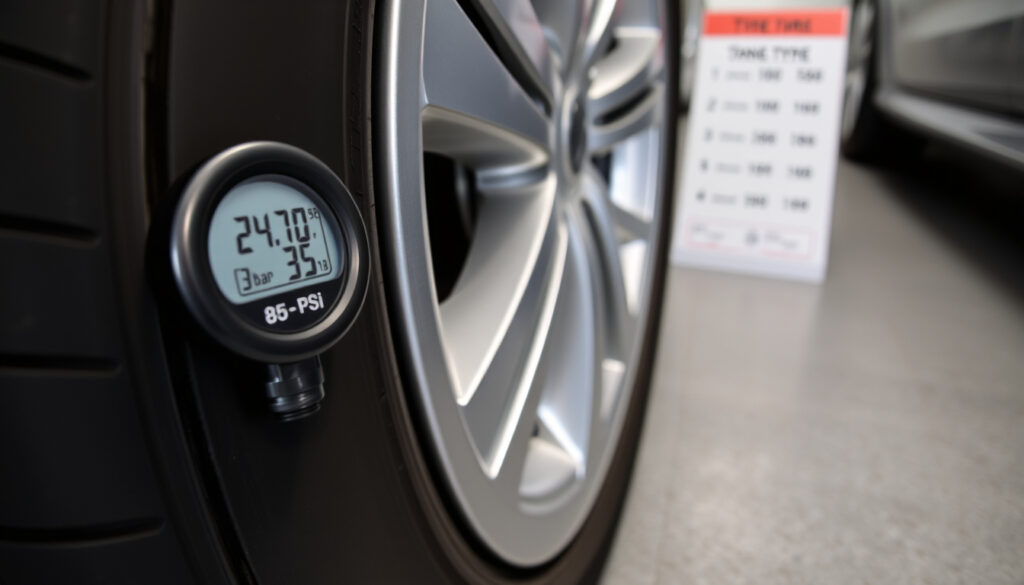
2.4 Bar in PSI: Complete Guide to Tyre Pressure Conversion
If you’ve ever glanced at your tyre pressure gauge and seen “2.4 bar” while wondering what that means in the more familiar PSI scale, you’re not alone—most UK drivers encounter this split-unit confusion regularly, since garages and tyre retailers switch between bar, PSI and kPa without warning. The math is straightforward, and getting it right matters: underinflated or overinflated tyres affect fuel economy, braking and tyre life.
2.4 Bar Equivalent: 34.81 PSI · Conversion Factor: 1 Bar = 14.5038 PSI · 2.5 Bar Equivalent: 36.26 PSI
Quick snapshot
- 2.4 bar equals 34.81 PSI (RAC Drive)
- Formula: bar × 14.5038 = PSI (Blackcircles)
- Vehicle-specific ideal pressure (Halfords UK)
- Whether 2.4 bar suits your specific car (Which?)
- Conversion factor standardised at 14.5038 (RAC Drive)
- UK/EU dual-unit usage ongoing (Tire Streets UK)
- Check your door sticker for exact PSI (Halfords UK)
- Verify tyre pressure when cold monthly (Blackcircles)
The following table summarises key conversion values and their sources for quick reference.
| Conversion | Value | Source |
|---|---|---|
| 2.4 Bar to PSI | 34.81 PSI (14.5038 × 2.4) | RAC Drive |
| 1 Bar Equivalent | 14.5038 PSI | Blackcircles |
| Standard Car Range | 2.2–2.8 Bar (32–40 PSI) | Halfords UK |
| 2.5 Bar to PSI | 36.26 PSI | Which? |
| 2.3 Bar to PSI | 33.36 PSI | Tire Streets UK |
What is 2.4 tyre pressure in PSI?
When you see 2.4 bar on your tyre gauge, the equivalent in PSI is 34.81 using the standard factor of 14.5038. Multiply the bar value by 14.5038 to get PSI: 2.4 × 14.5038 = 34.81. Some sources, such as Tire Streets UK, list the value as 34.83 due to rounding to two decimal places.
“A simple conversion to convert Bar to PSI is to multiply the pressure value in Bar by 14.5038.” — Which?
The implication: even a small difference of 0.02 bar (≈0.3 PSI) can affect tyre behaviour, so use the precise factor when accuracy matters.
How to convert Bar to PSI: a tyre pressure guide
Converting bar to PSI is a single multiplication step, but following a few extra checks ensures you get the right value for your vehicle.
- Locate the bar value on your tyre gauge (e.g., 2.4 bar).
- Multiply the bar value by 14.5038 to obtain PSI.
- Round the result to the nearest whole number if your gauge uses whole PSI.
- Compare the result with the recommended PSI on your vehicle’s door sticker or handbook.
- Adjust tyre pressure as needed, adding air to inflate or releasing air to deflate.
“1 PSI = 0.0689476 bar, so to convert PSI back to bar you divide by 14.5038.” — Unit Converters
The pattern: most UK tyre gauges display bar, while owner manuals often list PSI; converting correctly bridges this gap and helps maintain optimal tyre contact with the road.
Is 2.4 bar too high for tyre pressure?
2.4 bar falls within the typical recommended tyre pressure range for many passenger cars, which is generally between 2.2 and 2.6 bar (32–38 PSI). However, the exact ideal pressure depends on your vehicle’s specification.
Check the sticker on the driver’s door jamb or the vehicle handbook for the exact PSI recommendation. If the sticker lists PSI, convert your bar reading to PSI to compare directly.
The catch: tyre pressure that is too high can be just as dangerous as underinflation; always follow the vehicle-specific recommendation rather than a generic rule.
What should my tyre pressure be and how often should I check it?
Tyre pressure recommendations vary by make, model, and load. The driver’s door jamb sticker typically shows the recommended pressure in PSI or bar, sometimes both.
Use a reliable gauge or a petrol station’s air pump with a built-in gauge. If you use an online converter, such as the SensorsONE tool, ensure you input the exact bar value to get the PSI equivalent. For more information on tyre pressure, check out this Road tax calculator by registration. Road tax calculator by registration
The implication: regular checks prevent gradual pressure loss that can silently increase fuel consumption and shorten tyre life.
Is 2.5 bar tyre pressure too high?
2.5 bar is slightly above 2.4 bar and converts to approximately 36.26 PSI using the standard factor. For many vehicles, 2.5 bar is within the normal range, especially for heavier loads or when the manufacturer specifies a higher pressure for loaded conditions.
Check the manufacturer’s recommendation for your specific tyre type; if in doubt, use a tyre pressure gauge to verify. For a quick reference chart, see the British Metrics PSI‑BAR chart.
The catch: while 2.5 bar is often acceptable, it can exceed the recommended PSI for some cars, so cross-check with your door sticker to avoid overinflation.
Related reading: Korean Won to GBP Converter · Normal Blood Sugar Levels Chart
This common tyre pressure of 2.4 bar converts precisely to 34.81 PSI, as detailed in the exact 2.4 bar to PSI tire guide with practical charts and safety tips.
Frequently Asked Questions
What is 30-35 PSI in bar?
30 PSI ≈ 2.07 bar; 35 PSI ≈ 2.41 bar. Use the factor 1 PSI = 0.0689476 bar to convert.
What is 32 PSI tyre pressure?
32 PSI ≈ 2.21 bar. This is within the typical range for many passenger cars.
Is 40 PSI too high for tyres?
40 PSI ≈ 2.76 bar, which may exceed the recommended pressure for most passenger vehicles; check your door sticker for the correct value.
Is 36 PSI too high for a car?
36 PSI ≈ 2.48 bar, which is often within the upper end of the normal range for many cars, but can be high for some models; always verify with the manufacturer’s recommendation.
What is 2.3 BAR in PSI?
2.3 bar ≈ 33.36 PSI (2.3 × 14.5038).
What is 2.9 bar to PSI?
2.9 bar ≈ 42.06 PSI (2.9 × 14.5038).
What is 3.5 bar to psi?
3.5 bar ≈ 50.76 PSI (3.5 × 14.5038).
More related posts
 The Catcher in the Rye: Summary, Ban , and Holden’ Story
 Crest Nicholson Share Price (CRST): Live, Forecast & Analysis
 Fedora Hat: Symbolism, History, and Irish Buying Guide
 The Entertainer Toy Shop: Stores, News & Guide 2026
 Sylvia Plath: Life, Death, and Lasting Legacy
 What Language Do They Speak in Belgium? Dutch, French, German
 Tom Read Wilson: Gender, Relationship, and Nationality Facts
 O2 Customer Service Number UK – Free Contact & Opening Times
