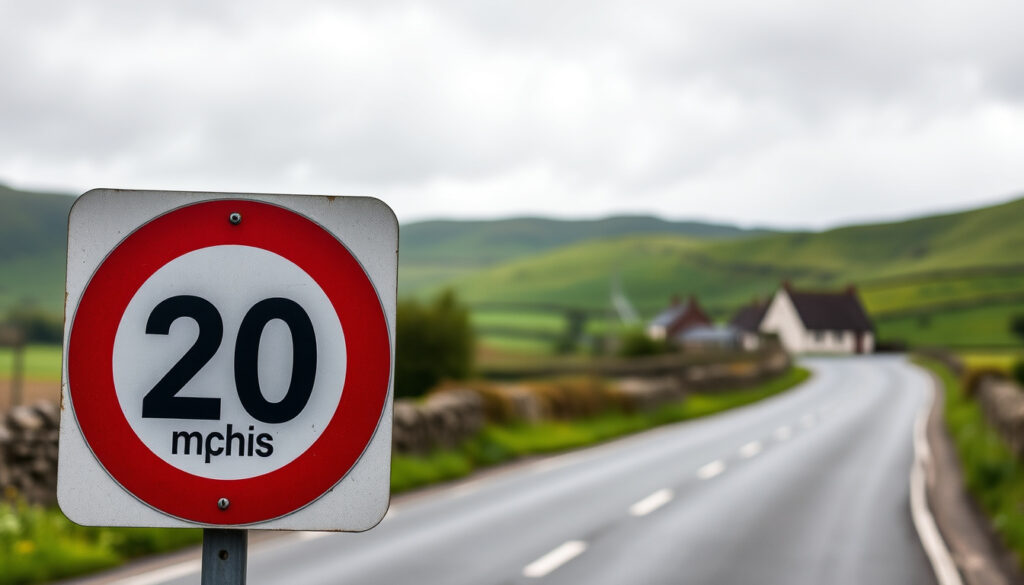
Wales 20mph Speed Limit: Current Status, Fines, and Overhaul Plans (2025)
When Wales became the first nation in the UK to drop the default speed on residential roads to 20 mph in September 2023, it felt like a quiet revolution. Two years on, the policy hasn’t vanished—but it has been through a bruising public debate and a government overhaul. Here’s what’s actually happened, what fines you still face, and why the speed limit you see depends on which road you’re on.
Default limit on restricted roads: 20 mph · Share of roads with 20 mph limit: 37% (as of Sept 2023) · Overhaul announced: September 2024 · Average speed drop on main through roads: 3.8 mph · Casualty reduction (first year): 26.2%
Quick snapshot
- Default 20 mph limit remains in force on restricted roads across Wales (Transport for Wales — National monitoring report July 2025)
- Overhaul announced September 2024, but no blanket removal (Welsh Government — Introducing 20mph speed limits: frequently asked questions)
- Early data shows reduction in road deaths and serious injuries (ETSC — Wales’ first full year of 20 mph default limits shows early safety gains and speed reductions)
- Exact list of roads that will revert to 30 mph – local reviews are ongoing
- Long-term public acceptance of the default 20 mph limit remains uncertain (local reviews are ongoing)
- Future changes after the full review (expected 2026 onward) are not yet defined (local reviews are ongoing)
- Default 20 mph live from September 2023; overhaul announced exactly one year later (Welsh Government — Introducing 20mph speed limits: frequently asked questions)
- Monitoring reports published July 2025 and March 2026 show early safety gains (ETSC — Wales’ first full year of 20 mph default limits shows early safety gains and speed reductions)
- Welsh Government reviewing local road exceptions – some may revert to 30 mph (Welsh Government — Introducing 20mph speed limits: frequently asked questions)
- Traffic regulation orders take several months; changes expected gradually from 2025 (Welsh Government — Introducing 20mph speed limits: frequently asked questions)
- Repeater signs on 20 mph roads to be removed by September 2024 (now ongoing) (Welsh Government — Introducing 20mph speed limits: frequently asked questions)
Five figures capture the scale of the change: from cost to casualty reduction, here are the headline numbers.
| Fact | Value |
|---|---|
| Default limit on restricted roads | 20 mph |
| Date limit introduced | September 2023 |
| Share of roads with 20 mph limit | 37% (as of Sept 2023) |
| Overhaul announcement | September 2024 |
| Average speed drop on main through roads | 3.8 mph |
| Casualty reduction (first year) | 26.2% |
| Implementation cost | ≈ £32 million |
| Estimated annual prevention savings | ≈ £92 million (research cited by Welsh Government) |
Is there still a 20mph speed limit in Wales?
Yes, the default 20 mph speed limit on restricted roads in Wales remains in force in 2025. The Welsh Government has not revoked it. In September 2024, Transport Secretary Ken Skates announced an “overhaul” of the policy – but that meant adjustments, not abandonment. The original intention of improving road safety stays central.
The term “overhaul” has caused confusion. It includes:
- Allowing local authorities to apply for exemptions on specific roads where 30 mph is more appropriate
- Publishing clearer guidance in July 2024 for highway authorities on criteria for retaining 30 mph
- No blanket return to 30 mph has been announced.
For the Welsh Government, the policy is not a U-turn but a fine-tuning. Critics wanted a full reversal; instead they got a review window. The trade-off: slower speeds on most roads still stand, but the door is open for local adjustments.
The implication: drivers should not assume the limit has disappeared; it remains the default.
Did Wales abandon the 20mph speed limit?
No – the 20 mph default limit has not been abandoned. The Welsh Government has repeatedly confirmed the policy remains in place, and the September 2024 overhaul was explicitly described as a “refinement” rather than a repeal. The original road safety objective – reducing collisions and saving lives – is unchanged.
What did change in September 2024?
- New guidance gave councils more discretion to identify roads where 30 mph is suitable.
- A dedicated team was set up to process traffic regulation order applications faster.
- The government committed to monitoring outcomes and reporting publicly – which it did in July 2025.
The implication: the policy has been adjusted, not junked. That distinction matters for drivers who might have heard rumours of a complete reversal.
If you were hoping for a wholesale return to 30 mph, the evidence says no. For councils, there’s now a formal route to change limits – but it’s a legal process that can’t be fast-tracked. For road safety campaigners, the core principle of lower speeds endures.
What this means: the policy has been refined, not reversed.
Is Wales reverting back to 30mph?
Only a portion of roads are being considered for reversion, not all. The Welsh Government has not announced a blanket return to 30 mph. Changes are expected to be implemented gradually, with some roads potentially seeing a change from 2025 onward.
The process works like this:
- Local highway authorities review roads where the default 20 mph may be inappropriate (e.g., main through roads with few pedestrians).
- If an exception is sought, a traffic regulation order must be made – a process that takes several months.
- The government has set no fixed target date for completions, but expects most decisions by 2026.
The pattern: the default 20 mph remains across the vast majority of restricted roads, but a small number of exceptions (likely on faster rural roads or main routes through villages) will be made on a case-by-case basis.
Will I get points for doing 24 in a 20?
Yes, you can get penalty points for driving 24 mph in a 20 mph zone. Speeding at 4 mph over the limit falls outside the typical police enforcement tolerance (which varies but is often around 10% + 2 mph in the UK). That means 24 mph in a 20 zone is likely to trigger a Fixed Penalty Notice.
Typical penalties:
- 24 mph in a 20 mph zone: 3 penalty points and a £100 fine (standard starting level).
- Higher speeds: Could lead to court summons, more points (up to 6), and fines up to £1,000 (or £2,500 on motorways).
- Speed awareness course: May be offered as an alternative for first-time offenders at the lower range, but not guaranteed (UK Government — Speeding penalties).
What this means: driving 24 mph in a 20 zone is not a trivial infringement. The police in Wales have confirmed they are enforcing the 20 mph limit, including with mobile speed cameras and fixed sites.
What impact has the 20mph speed limit had on road safety in Wales?
Early data from the Transport for Wales national monitoring report (July 2025) shows measurable safety gains. The share of roads with a 20 mph limit jumped from 2% to 37% after September 2023, and that change has already translated into fewer casualties.
- Vehicle speeds on 20 mph main through roads fell by an average of 3.8 mph.
- The proportion of vehicles driven at or below 24 mph rose from 20.8% to 54.0%.
- Casualties on roads previously subject to 20 mph or 30 mph limits decreased by 26.2% in the first year after the change, according to ETSC’s summary of the TfW report.
- Weighted mean speed on monitored roads dropped to 24.9 mph, and the 85th-percentile speed fell to 29.5 mph.
Law firm PJA noted in May 2026 that “two and a half years of 20 mph limits have saved lives in Wales” (PJA — Two and a half years of 20mph in Wales have saved lives). The trade-off: journey times increased slightly, but the casualty reduction is substantial.
Timeline of the Wales 20mph speed limit
- – The Restricted Roads (20 mph Speed Limit) (Wales) Order 2022 is passed by the Senedd.
- – Default 20 mph limit on restricted roads goes live across Wales.
- – Public backlash and political pressure lead to a government review; overhaul announced in September 2024.
- – Gradual adjustments to specific roads begin; monitoring reports published by Transport for Wales (July 2025) and Senedd Research (March 2026) show safety gains.
What’s clear and what’s not about the 20mph limit
Confirmed facts
- 20 mph default limit remains in place across most restricted roads in Wales
- Overhaul started in September 2024 to address public concerns
- Early safety data shows reduction in road deaths and injuries
- Implementation cost was about £32 million
What’s unclear
- Exact list of roads that will revert to 30 mph – local reviews are ongoing
- Long-term public acceptance of the policy is still unknown
- Future changes after the full review (expected 2026 onward) are not yet defined
- The long-term economic impact of the policy is not yet fully quantified.
What experts say
The 20 mph default limit is the first national policy of its kind in the UK. We are monitoring its impact closely and will continue to refine implementation based on evidence.
Transport for Wales — National monitoring report July 2025
Two and a half years of 20 mph limits in Wales have saved lives. The evidence is clear: lower speeds mean fewer deaths and serious injuries.
PJA Law — Two and a half years of 20mph in Wales have saved lives
The first full year of default 20 mph limits shows early safety gains and substantial speed reductions. The 26% drop in casualties is a strong signal that the policy is working.
European Transport Safety Council — Wales’ first full year of 20 mph default limits
For Welsh drivers, the 20 mph limit is not going away – but it is being fine-tuned. The government’s message is clear: the default stays, but councils can argue for exceptions. The safety data already shows a payoff in fewer casualties. For campaigners who wanted a full repeal, the outcome is a partial concession: a review process, not a reversal. For road safety advocates, the policy has delivered on its promise. The choice for anyone driving in Wales now is simple: obey the 20 mph signs, or risk the points and fines that still apply.
I likhet med Wales översyn av 20 mph-gränsen möter förare i Kent också förändringar genom temporära hastighetsbegränsningar i Storbritannien som införts i samband med vägarbeten.
Frequently asked questions
Are all roads in Wales 20mph now?
No. Only “restricted roads” (those with street lighting and no higher limit signs) have a default 20 mph. Motorways, dual carriageways, and many A-roads retain their previous limits (e.g., 70 mph on motorways, 60 or 50 mph on some A-roads).
What is a ‘restricted road’ under Welsh law?
A restricted road is a road with a system of street lighting (lamps placed no more than 200 yards apart) that has a speed limit of 20 mph unless signs indicate otherwise. This is defined in the Road Traffic Regulation Act 1984 and amended by Welsh legislation.
How fast can I drive on motorways and dual carriageways in Wales?
Motorways remain at 70 mph (unless lower limits are posted). Dual carriageways are generally 70 mph for cars and 60 mph for vehicles towing. These limits are unaffected by the 20 mph policy.
What should I do if I believe a road should have a different speed limit?
Contact your local highway authority (the council for the area). They can initiate a traffic regulation order to change the limit, but the process takes several months and must be approved by the Welsh Government’s guidelines.
Can I get caught by a speed camera in a 20mph zone in Wales?
Yes. Fixed speed cameras and mobile enforcement (including vans) are in regular use on 20 mph roads in Wales. Police forces have confirmed they are enforcing the limit.
What are the rules for cyclists on 20mph roads?
Cyclists are not subject to the 20 mph speed limit (they are not motor vehicles). However, they must follow all other traffic laws. The lower speed environment is generally considered safer for cyclists.
Will speed limits change on A-roads in Wales?
No blanket change is planned for A-roads. Individual A-road sections may be reviewed if they are classified as restricted roads (e.g., through villages with street lighting). Any changes would be decided via traffic regulation orders.
Related reading
More related posts
 Club Brugge vs Rangers: History, Results & Key Questions
 Most Spoken Language in the World – English vs Mandarin 2025
 Who Was Melania Trump Before She Married? Early Life & Career
 Connections New York Times: Hints, How to Play & Today
 Best Toddler Car Seats – Top Safety Picks for 2025
 Air Wick Essential Mist: How to Use, Settings & Fixes
 Cherry Eye in Dogs: Causes, Treatment & Surgery Cost Guide
 Restaurants Near Me for Dinner: Mullingar Dining Guide
